Nurses Missed Lunch Breaks: How to Actually Get Your Break (and Get Paid When You Can't)
Skipping lunch isn't a badge of honor. It's a staffing gap. Here's how to close it on your unit.

Photo: Vanessa Loring / Pexels
Ask any floor nurse when they last took a full, uninterrupted 30-minute lunch and you'll often get a laugh. Breaks slide because nobody is free to watch your patients, because a discharge lands at 1130, or because "it's just faster if I eat at the station."
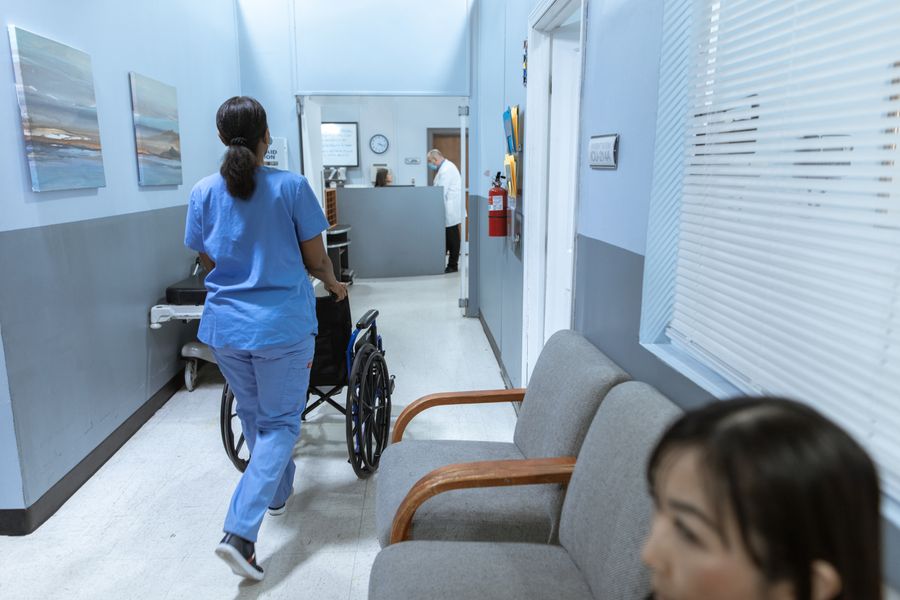
Photo: RDNE Stock project / Pexels
Here's what's worth knowing. Federal law does not require employers to give lunch or coffee breaks, but when short breaks of about 5 to 20 minutes are offered, they count as paid work time, and genuine meal periods (typically 30 minutes or more) are treated as unpaid time (U.S. Department of Labor, Breaks and Meal Periods, accessed 2026, dol.gov/general/topic/workhours/breaks). That means the real rules usually come from your state and your employer.
Some states go much further. Washington, for example, requires hospitals to give covered direct-care employees uninterrupted meal and rest breaks (with narrow exceptions for emergencies), to keep a way to record missed breaks, and to report missed breaks to the state each quarter (Washington State Legislature, RCW 49.12.480, amended 2025, app.leg.wa.gov/rcw/default.aspx?cite=49.12.480). Other states have little beyond the federal baseline.
So the practical question is: what does your hospital's policy say about missed and interrupted meals, and does your timekeeping system let you record them? Under the federal rule, an unpaid ("bona fide") meal period requires that you be completely relieved from duty. Ordinarily 30 minutes or more is long enough. You are not relieved if you're required to perform any duties, whether active or inactive, while eating, and the rule gives the example of an employee who is required to eat at their desk. You don't have to be allowed to leave the building, as long as you're otherwise completely freed from duties (29 CFR 785.19, Electronic Code of Federal Regulations, accessed 2026, ecfr.gov/current/title-29/subtitle-B/chapter-V/subchapter-B/). In practice, a "lunch" spent holding your phone for your patients or answering call lights may not be a true meal break. Record it, and ask HR or payroll how your employer handles it. State law may add more protections.
Practical takeaways:
- If you're expected to stay reachable or keep working during your meal, it may not count as a bona fide unpaid meal period under 29 CFR 785.19. Record it as missed or interrupted.
- Find your employer's written meal and rest break policy and your timekeeping code for a missed or interrupted meal. Use it every time, not just on the worst days.
- Hand off before you leave: name the nurse covering, list the time-sensitive items (meds due, pending labs, fall-risk patients), and say when you'll be back.
- Ask your unit about a break-nurse or "break buddy" model, where one nurse covers a pod's breaks in rotation. Bring it to staff meeting or unit council as a patient-safety item, not a perk.
- If missed breaks are a pattern, document dates and reasons (a simple note on your phone works) and raise it with your manager or practice council.
Scripts:
- To the charge nurse at 1100: "I'd like to take my lunch between 1200 and 1230. Can [name] cover 12 through 15? I'll give a quick handoff before I go."
- When it keeps slipping: "I haven't had a break yet and it's 1400. I need 30 minutes. Who can cover my patients?"
- To your manager: "I've missed my meal on [number] of my last [number] shifts. I'm recording them, but I'd rather fix the coverage. Could we try a break-nurse rotation for a month?"
Sources: U.S. Department of Labor, Breaks and Meal Periods, dol.gov/general/topic/workhours/breaks · 29 CFR 785.19 (eCFR), ecfr.gov/current/title-29/subtitle-B/chapter-V/subchapter-B/ · Washington RCW 49.12.480, app.leg.wa.gov/rcw/default.aspx?cite=49.12.480